Chess variants

|
Annotated by Rob Stolzenbach
|
Steinitz is thought to have said that the best position for a Pawn is its original place: in other words, don’t move them!
The Black player in this game is “famous” for throwing his pawns forwards at will. Why doesn’t he do so in this game? Some premonition?
Jan Smit – Rob Stolzenbach 15-11-2016
Regular Chess board and setup, except for the following:
Femme Fatale (F): c1 and c8
Two step moves to any empty vacant square—the Femme Fatale cannot capture. Any enemy piece adjacent to a Femme Fatale cannot capture or check.
Joker (J): d1 and d8
The Joker moves and captures exactly like the piece that the opponent last moved.
Princess (Grand Chess Cardinal) (P): f1 and f8
Moves like a Knight or a Bishop
Empress (Grand Chess Marshall (E): g1 and g8
Moves like a Knight or Rook
The Black player in this game is “famous” for throwing his pawns forwards at will. Why doesn’t he do so in this game? Some premonition?
Jan Smit – Rob Stolzenbach 15-11-2016
Regular Chess board and setup, except for the following:
Femme Fatale (F): c1 and c8
Two step moves to any empty vacant square—the Femme Fatale cannot capture. Any enemy piece adjacent to a Femme Fatale cannot capture or check.
Joker (J): d1 and d8
The Joker moves and captures exactly like the piece that the opponent last moved.
Princess (Grand Chess Cardinal) (P): f1 and f8
Moves like a Knight or a Bishop
Empress (Grand Chess Marshall (E): g1 and g8
Moves like a Knight or Rook
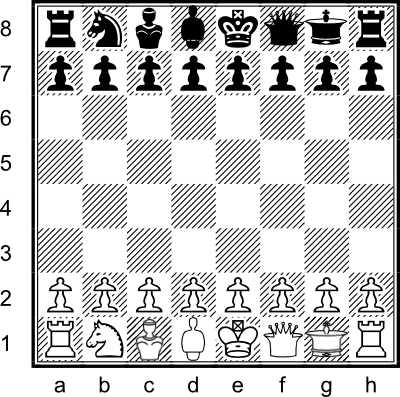
Setup for the game
1. e4 Nc6
2. g4 (Very usual pawn move in Superchess!)
2.... Pe6,
3. Fd3 Jd6 (Quite early)
2. g4 (Very usual pawn move in Superchess!)
2.... Pe6,
3. Fd3 Jd6 (Quite early)
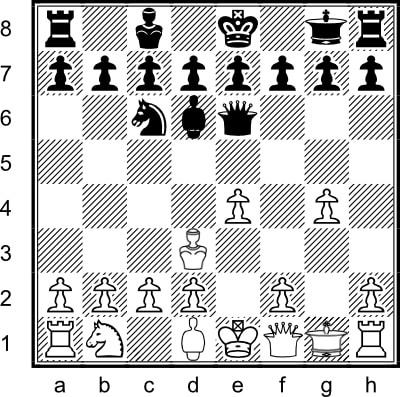
Position after 3...Jd6
4. Nc3 Nb4
5. Fb5 Jd4 (Daring!)
6. a3 Nc6
7. Fd5 (The hyperactive Femme Fatale, the White player’s specialty)
5. Fb5 Jd4 (Daring!)
6. a3 Nc6
7. Fd5 (The hyperactive Femme Fatale, the White player’s specialty)
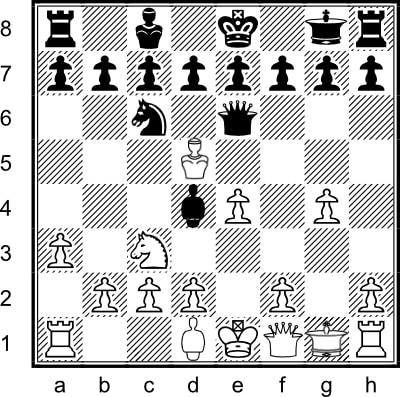
Position after 7.Fd5
7.... Ne5
8. Nb5 Fc6
9. c3 Pg5 (According to plan)
10. cxd4 Nf3+
8. Nb5 Fc6
9. c3 Pg5 (According to plan)
10. cxd4 Nf3+
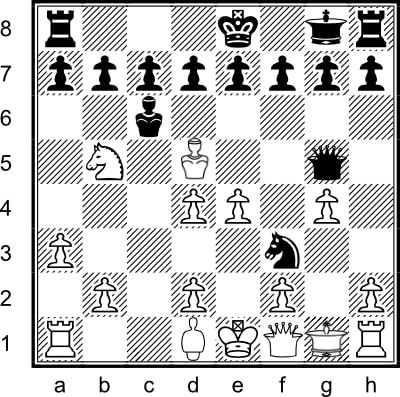
Position after 10....Nfe+
11. Ff4 Ef6
12. Fg3 Exe4+
13. Ff4 Ee6+
12. Fg3 Exe4+
13. Ff4 Ee6+
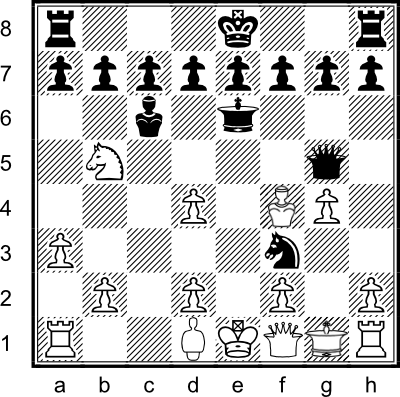
Position after 13.... Ee6+
14. Je3 Exf4+ (Check by the Black Knight, since White’s Femme Fatale is taken)
15. Exf3 Pxf3 mate (15. Jxf3 would have been better)
Black jokingly thought this was his best game ever! ◾️
15. Exf3 Pxf3 mate (15. Jxf3 would have been better)
Black jokingly thought this was his best game ever! ◾️
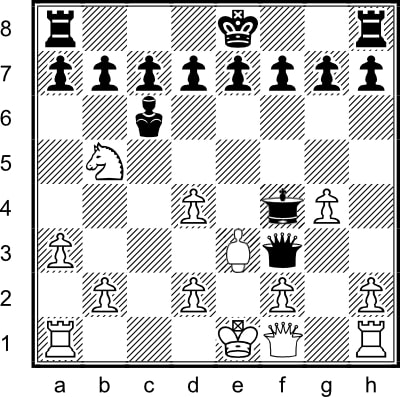
Final position after 15.... Pxf3 mate
🔴⚫️🔴⚫️🔴⚫️🔴
An amazing finish to the game, with Black moving neither a Rook, Pawn, nor his King, and a very clean mate. The game also demonstrates use of two of the strangest Superschaak pieces, Joker and Femme Fatale. Superschaak in this form can be played with a regular Chess set, provided the fairy pieces are marked in some way. The Superschaak website give further examples of unusual pieces for experimentation, and sets of custom pieces can be purchased. Remember, in a Superschaak game, the choice of armies should be the same, but the setups can be different; Superschaak pieces simply displace the Chess pieces they replace, with the regular Chess pieces remaining in their standard positions; the Emperor, if used, must be centralized next to the King.
Although I reviewed the Superschaak summary booklet myself in AG23, here is another review, below, by David Pritchard, dating back to February 2000. David's review covers the main hardcopy book as well as the summary booklet. I rediscovered this document only recently in the archives of the old series of Abstract Games, when converting correspondence to digital format. Connie and I visited David and his wife Elaine at their home in Godalming, England, in 2000. He taught me the game Lost Cities, which was new at the time, and which he recommended. David and Elaine were lovely people, and we were very sad at David's passing in 2005. So, here is David's review, saved from obscurity. I have left his original wording, where he uses the English "Superchess" rather than the Dutch "Superschaak." ~ Editor
Although I reviewed the Superschaak summary booklet myself in AG23, here is another review, below, by David Pritchard, dating back to February 2000. David's review covers the main hardcopy book as well as the summary booklet. I rediscovered this document only recently in the archives of the old series of Abstract Games, when converting correspondence to digital format. Connie and I visited David and his wife Elaine at their home in Godalming, England, in 2000. He taught me the game Lost Cities, which was new at the time, and which he recommended. David and Elaine were lovely people, and we were very sad at David's passing in 2005. So, here is David's review, saved from obscurity. I have left his original wording, where he uses the English "Superchess" rather than the Dutch "Superschaak." ~ Editor
Superchess by Dr. H. van Haeringen
Reviewed by David Pritchard
Dr. van Haeringen published the rules of his game Superchess and a related game, Monarch, in English back in 1993. In 1999 he published what must be one of the handsomest books ever produced on a chess variant. The large-format hardback Schaak en Superschaak (in Dutch) has 176 double-column pages with big, clear 4"x 4" diagrams. The text is a greatly enlarged version of the 22-page English booklet which was confined to rules of play. The new book includes annotated games, positions and problems as well as the laws of the games.
Superchess is is not itself a game; rather it is a menu of options. This is chess free-style, with players determining prior to play which pieces, starting position and board they want to play with. Superchess offers a mind-blowing fifty new pieces to choose from. The moves of all fifty pieces are fully described and in addition these are conveniently illustrated on a double-sided card included with the book. A few of the pieces will be familiar to variant players but most will not as they are the creations of the inventor's imagination. The game concept is not original. Ralph Betza's Simple Armies (1980) and Bruce Gilson's Free Choice Chess (1984), which offered a selection of 17 different pieces, had much the same do-it-yourself idea.
The book includes four annotated games of which the first three involve the Princess (B+N) and the Amazon (Q+N). Game 3 runs to just ten moves when the author offers two diverging lines running to 19 and 32 moves respectively. This game covers no less than nine double-column pages, nearly all analysis. In game 4 two new pieces are introduced, the Elephant and the Herald. The Elephant moves as a queen up to two squares but can also capture on the first square of a two-square move so two men can be captured in the one turn. The Herald moves one or two squares diagonally, leaping if necessary, and when reaching the end rank can also move one square horizontally thus changing square colour. One Herald moves once in this game. I would have much preferred to see the considerable space taken up by these games to have been used to demonstrate the interaction in game situations of some of the other pieces.
Anyone can of course invent chessmen with new moves. But it is not as easy as that. Arguably, certain combinations of pieces harmonize whilst other do not (one reason that the established forms of chess are such good games is because of the interaction of their pieces). The author does not mention this important aspect of chess games and the reader is left to discover which pieces work well together and which do not.
Van Haeringen has produced many of his pieces in turned wood in neo-Staunton design intended to harmonize with standard chessmen. A selection of these pieces, which can be purchased through the author, is illustrated on the book's cover.
My initial reaction to Superchess was to be totally overwhelmed by all the new pieces. However, it must be borne in mind that one is not expected to digest them all at a sitting. The idea is to agree perhaps one or two new pieces in place of existing pieces when first playing a game, and then to absorb selected new pieces gradually.
Monarch I found a somewhat perplexing postscript as the game seems to be simply a version of Superchess played on a 10x8 or 10x10 board. The inventor considers Chess to be an imperfect game (many would agree). His aim is to improve chess (an aim held by other ambitious but failed variant inventors of the past). He is hopeful that Superchess will one day be developed into the "perfect" game. Something of a pipe-dream I fear, for who is to determine what constitutes "perfect"? Apparently a consortium of expert chessplayers according to van Haeringen. He foresees that these, "after years of practice," will eventually achieve the ultimate chess game—best possible piece combination, starting position and board size.
I regret that I do not share van Haeringen's optimism. An inventor of a chess variant, however good the game, must face some unpleasant facts:
It is small wonder that support for chess variants has always been limited but at least in one direction there is light: each new variant will offer original themes for problemists, and Superchess, with its horde of new pieces, must offer enough new themes to fill anyone's lifetime.
Reviewed by David Pritchard
Dr. van Haeringen published the rules of his game Superchess and a related game, Monarch, in English back in 1993. In 1999 he published what must be one of the handsomest books ever produced on a chess variant. The large-format hardback Schaak en Superschaak (in Dutch) has 176 double-column pages with big, clear 4"x 4" diagrams. The text is a greatly enlarged version of the 22-page English booklet which was confined to rules of play. The new book includes annotated games, positions and problems as well as the laws of the games.
Superchess is is not itself a game; rather it is a menu of options. This is chess free-style, with players determining prior to play which pieces, starting position and board they want to play with. Superchess offers a mind-blowing fifty new pieces to choose from. The moves of all fifty pieces are fully described and in addition these are conveniently illustrated on a double-sided card included with the book. A few of the pieces will be familiar to variant players but most will not as they are the creations of the inventor's imagination. The game concept is not original. Ralph Betza's Simple Armies (1980) and Bruce Gilson's Free Choice Chess (1984), which offered a selection of 17 different pieces, had much the same do-it-yourself idea.
The book includes four annotated games of which the first three involve the Princess (B+N) and the Amazon (Q+N). Game 3 runs to just ten moves when the author offers two diverging lines running to 19 and 32 moves respectively. This game covers no less than nine double-column pages, nearly all analysis. In game 4 two new pieces are introduced, the Elephant and the Herald. The Elephant moves as a queen up to two squares but can also capture on the first square of a two-square move so two men can be captured in the one turn. The Herald moves one or two squares diagonally, leaping if necessary, and when reaching the end rank can also move one square horizontally thus changing square colour. One Herald moves once in this game. I would have much preferred to see the considerable space taken up by these games to have been used to demonstrate the interaction in game situations of some of the other pieces.
Anyone can of course invent chessmen with new moves. But it is not as easy as that. Arguably, certain combinations of pieces harmonize whilst other do not (one reason that the established forms of chess are such good games is because of the interaction of their pieces). The author does not mention this important aspect of chess games and the reader is left to discover which pieces work well together and which do not.
Van Haeringen has produced many of his pieces in turned wood in neo-Staunton design intended to harmonize with standard chessmen. A selection of these pieces, which can be purchased through the author, is illustrated on the book's cover.
My initial reaction to Superchess was to be totally overwhelmed by all the new pieces. However, it must be borne in mind that one is not expected to digest them all at a sitting. The idea is to agree perhaps one or two new pieces in place of existing pieces when first playing a game, and then to absorb selected new pieces gradually.
Monarch I found a somewhat perplexing postscript as the game seems to be simply a version of Superchess played on a 10x8 or 10x10 board. The inventor considers Chess to be an imperfect game (many would agree). His aim is to improve chess (an aim held by other ambitious but failed variant inventors of the past). He is hopeful that Superchess will one day be developed into the "perfect" game. Something of a pipe-dream I fear, for who is to determine what constitutes "perfect"? Apparently a consortium of expert chessplayers according to van Haeringen. He foresees that these, "after years of practice," will eventually achieve the ultimate chess game—best possible piece combination, starting position and board size.
I regret that I do not share van Haeringen's optimism. An inventor of a chess variant, however good the game, must face some unpleasant facts:
- Recruits to chess variants come almost without exception from the ranks of chessplayers often, let it be sadly said, because they failed as chessplayers;
- In adopting a new variant, a chessplayer is being asked to discard the accumulated knowledge of years, perhaps decades of experience and study;
- A new chess variant (and nearly all old ones come to that) lacks the infrastructure that chessplayers enjoy—the clubs, tournaments, national and international events and the vast library of information and literature that has grown over the centuries .
It is small wonder that support for chess variants has always been limited but at least in one direction there is light: each new variant will offer original themes for problemists, and Superchess, with its horde of new pieces, must offer enough new themes to fill anyone's lifetime.