Domino games

|

by Don Kirkby
|
Sid Sackson is one of my favourite game designers. He designed Acquire, Can’t Stop, and I’m the Boss, among many, many others. I first got interested in designing board games when I found his book, A Gamut of Games, in the basement of our city's oldest library. He described so many different kinds of games designed by him and his friends that I started to come up with my own game ideas.
In 2015, I started designing new puzzles and games to play with a standard set of dominoes. After creating a couple of my own, I was pleasantly surprised when I found a copy of his Beyond Solitaire book, and it included Mountains and Valleys. I adapted it from paper, pencil, and dice to use dominoes, and included it in my Donimoes collection, which I recently published as a book of a dozen puzzles and games.
To start, shuffle a set of double-six dominoes face down, then turn 18 of them face up. The remaining 10 aren’t used. Then arrange the dominoes into a 6x6 square of numbers that represents a map of mountains and valleys, where blanks are at sea level, and sixes are the highest peaks. The goal is to make a map where you can walk to every square. You can walk from one square to its neighbour if the two heights are the same or differ by one. (You can’t climb cliffs.)
For example, this set of 18 dominoes can be arranged into the solution below, where the grey lines show the paths you can walk along:
In 2015, I started designing new puzzles and games to play with a standard set of dominoes. After creating a couple of my own, I was pleasantly surprised when I found a copy of his Beyond Solitaire book, and it included Mountains and Valleys. I adapted it from paper, pencil, and dice to use dominoes, and included it in my Donimoes collection, which I recently published as a book of a dozen puzzles and games.
To start, shuffle a set of double-six dominoes face down, then turn 18 of them face up. The remaining 10 aren’t used. Then arrange the dominoes into a 6x6 square of numbers that represents a map of mountains and valleys, where blanks are at sea level, and sixes are the highest peaks. The goal is to make a map where you can walk to every square. You can walk from one square to its neighbour if the two heights are the same or differ by one. (You can’t climb cliffs.)
For example, this set of 18 dominoes can be arranged into the solution below, where the grey lines show the paths you can walk along:
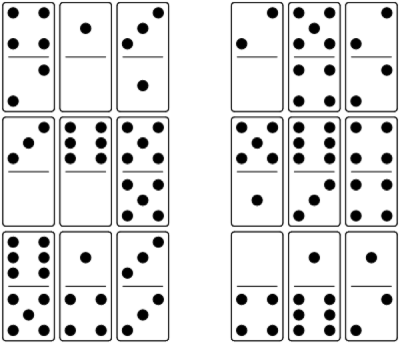
Sample collection of 18 dominoes
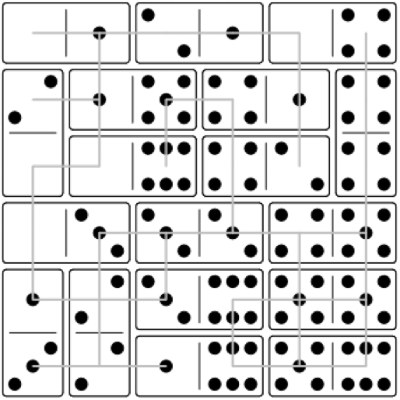
Possible solution
I like this solitaire, because it can almost always be solved, though finding a solution can be very difficult. There’s usually more than one solution. For example, you can flip the 5-6 domino, above. There is a trivially unsolvable situation, but it can be quickly checked after dealing. Luckily, it only happens roughly once in every 2000 deals, and I haven't found any other unsolvable combinations after running thousands of simulations. Readers might enjoy working out how to check for unsolvable deals and calculating the exact odds. See the solution page for the answer.
Extra Difficulty
If you want to make it harder, draw 18 dominoes, but only turn five of them face up. Each time you play a domino, turn another one face up, until you’ve turned up all 18. Then play the last five. After the first domino, all dominoes must be played so they have at least one neighbour, and they can’t be moved after they are added.
When the 6x6 square is complete, see if the whole map is connected as described in the regular game. If you need a step of more than one level to get from one section of the map to another, you get a penalty of the number of levels. For example, if a map is completely connected except that you need to go from a 3 to a 5, then you would have a 2 point penalty. A perfect game is zero, and anything under 5 is a good game. ◾️
Extra Difficulty
If you want to make it harder, draw 18 dominoes, but only turn five of them face up. Each time you play a domino, turn another one face up, until you’ve turned up all 18. Then play the last five. After the first domino, all dominoes must be played so they have at least one neighbour, and they can’t be moved after they are added.
When the 6x6 square is complete, see if the whole map is connected as described in the regular game. If you need a step of more than one level to get from one section of the map to another, you get a penalty of the number of levels. For example, if a map is completely connected except that you need to go from a 3 to a 5, then you would have a 2 point penalty. A perfect game is zero, and anything under 5 is a good game. ◾️
🔴⚫️🔴⚫️🔴⚫️🔴
Don Kirkby has written a book on competitive and solitaire domino games, Donimoes: New Games and Puzzles, available for order from his website, here. I hope to review Don's book in the next issue. Don's investigations in dominoes are significant, in my view. The domino system has tended to take a back seat to the playing cards, although the structure of the domino set is mathematically perfect. The cards have suits and numbers; the dominoes just have numbers, but the two numbers on a single domino can play the same or contrasting roles. There is plenty of untapped opportunity for game designers. ~ Editor