Domino games

|

by Don Kirkby
|
Roland Siegers used an unusual mechanic in two board games: Winkel-Advokat (1986) and Cabale (1999). Each turn, your runner makes a V-shaped move, and drops a marker at the bend. I’ve played many games of Cabale, which uses a hexagonal grid. When I learned that Winkel-Advokat uses the same mechanic on a square grid, I thought it would adapt well to play on a grid of dominoes, as part of Donimoes, my collection of new domino games and puzzles.
Equipment
Start
Shuffle all the dominoes face down, and then place them in a 7x8 grid of numbers, flipping them face up as you go.
Randomly choose colours for the two players. The player with the darker colour starts, placing their runner on one end of any domino. The player with the lighter colour then has a choice: either place their runner somewhere else on the dominoes, or swap colours and force the other player to place the lighter runner. This means that if the first player makes too strong a first move, the second player can steal it.
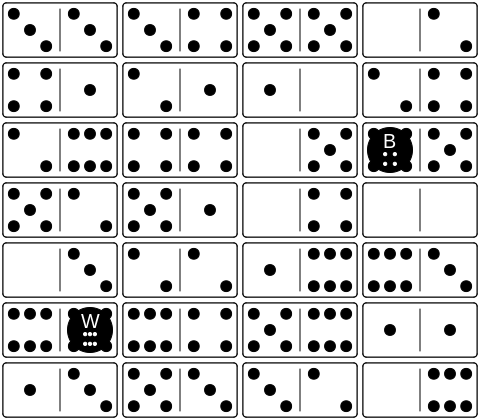
Here’s an example starting position, where there are several fives and sixes protected by blanks or the edge of the board. The black player decided to line up with two of the fives, so the white player would choose to line up with a six instead of swapping colours. The little white pips show you what number is underneath each runner.
Equipment
- A set of dominoes from double blank to double six
- Ten checkers for each player, in different colours, that will fit on half a domino
- One runner for each player, in colours to match the checkers, they can be pawns or a stack of two checkers
- A neutral runner in a third colour (optional)
Start
Shuffle all the dominoes face down, and then place them in a 7x8 grid of numbers, flipping them face up as you go.
Randomly choose colours for the two players. The player with the darker colour starts, placing their runner on one end of any domino. The player with the lighter colour then has a choice: either place their runner somewhere else on the dominoes, or swap colours and force the other player to place the lighter runner. This means that if the first player makes too strong a first move, the second player can steal it.
Here’s an example starting position, where there are several fives and sixes protected by blanks or the edge of the board. The black player decided to line up with two of the fives, so the white player would choose to line up with a six instead of swapping colours. The little white pips show you what number is underneath each runner.
Example starting position
Play
On each turn, move your runner in two parts: vertical then horizontal or horizontal then vertical. Each part must move at least one space across the board. Start by replacing your runner with the neutral runner, then move your runner as described. It cannot cross over another runner or any checkers. After moving the runner, place one of your checkers on the space where the runner changed direction. Important: you cannot place a checker on a blank space, so you cannot change direction on a blank space.
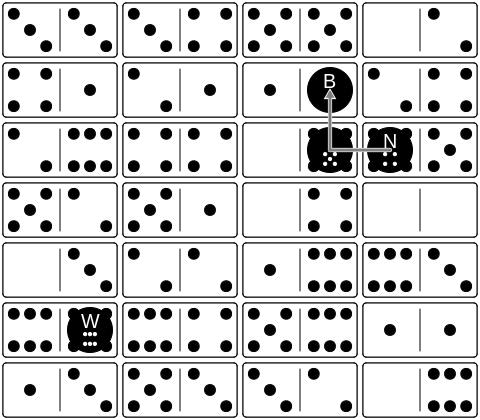
Here’s what the black player might do on the first move of the example game. The neutral runner is optional, and helps you see where you started your move. The black runner turned at the 5 and dropped a black checker, then moved up to the blank and stopped.
On each turn, move your runner in two parts: vertical then horizontal or horizontal then vertical. Each part must move at least one space across the board. Start by replacing your runner with the neutral runner, then move your runner as described. It cannot cross over another runner or any checkers. After moving the runner, place one of your checkers on the space where the runner changed direction. Important: you cannot place a checker on a blank space, so you cannot change direction on a blank space.
Here’s what the black player might do on the first move of the example game. The neutral runner is optional, and helps you see where you started your move. The black runner turned at the 5 and dropped a black checker, then moved up to the blank and stopped.
Black's first move
After placing the checker, you may use it to jump over one of your opponent’s checkers, if the two checkers are right next to each other and there’s an empty space on the other side. You may not jump diagonally, and you may not land on a blank space. You may continue jumping another checker after you land, with the same rules.
Once you finish, your opponent takes a turn.
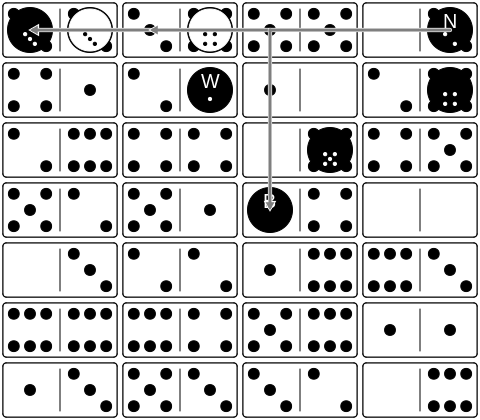
After a few moves in the example game, the white player has left some checkers unprotected. You can see the neutral runner where the black runner started, and the corner where the black player dropped a checker. Then that checker jumped over the white checker on the four and then over the white checker on the three. Both the white checkers can now be removed by the black player.
Once you finish, your opponent takes a turn.
After a few moves in the example game, the white player has left some checkers unprotected. You can see the neutral runner where the black runner started, and the corner where the black player dropped a checker. Then that checker jumped over the white checker on the four and then over the white checker on the three. Both the white checkers can now be removed by the black player.
Example of jumping
Game end
The game ends in one of two ways: either both players place all their checkers, or a player can’t make a legal move. If a player can’t make a legal move, they lose. If both players have played all their checkers, look under the checkers, and add up all the covered numbers, then add one more point for every captured checker. The player with the most points wins.
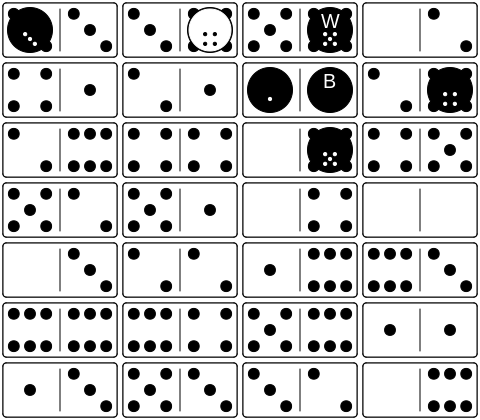
In the example game, the white player has made another mistake, and can’t make a legal move. You might think that white could move one to the right and then down the empty column, but remember that you can’t drop a checker on a blank. White loses the game, and it doesn’t matter how many points are under the checkers. ◾️
The game ends in one of two ways: either both players place all their checkers, or a player can’t make a legal move. If a player can’t make a legal move, they lose. If both players have played all their checkers, look under the checkers, and add up all the covered numbers, then add one more point for every captured checker. The player with the most points wins.
In the example game, the white player has made another mistake, and can’t make a legal move. You might think that white could move one to the right and then down the empty column, but remember that you can’t drop a checker on a blank. White loses the game, and it doesn’t matter how many points are under the checkers. ◾️
White has lost.
🔴⚫️🔴⚫️🔴⚫️🔴
Domino Runners is an unusual way of using Dominoes. It has something of Winkel-Advokat and Cabale, but it is its own game. The double-six set creates what seems to be an ideal board size for this type of game. The distribution of high numbers and blanks adds strategic and tactical interest. The random start ensures the game is endlessly variable. You can win by scoring, but the win by immobilizing your opponent gives the game an aggressive edge. It might be the best new use of dominoes since Sid Sackson's The Domino Bead Game, published in his book A Gamut of Games (1969). ~ Ed.